The Bilingual Household Paradox: When Raising Multilingual Children Quietly Erodes the Parent's Own Language
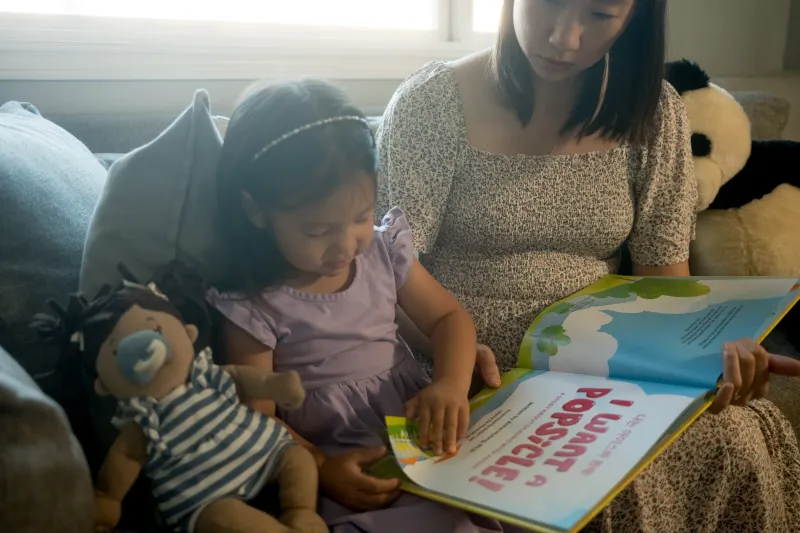
Photo: parent reading bilingual children's book with young child at home, via www.mindfulpeach.co
Across the United States, a growing number of families are making a deliberate choice to raise children in two or more languages. The motivations vary—heritage preservation, cognitive advantage, professional opportunity—but the aspiration is consistent: give the next generation a linguistic gift that takes decades to fully appreciate.
What the parenting books rarely mention is what this project may quietly cost the adults doing the giving.
A Hidden Side Effect Nobody Warned You About
Clinical linguists and psycholinguistics researchers have increasingly documented a phenomenon that many multilingual parents recognize the moment it is named: a gradual softening of their own language abilities during the intensive years of raising bilingual children. It shows up in small ways at first. A word that should arrive instantly takes a half-second longer. A sentence in the heritage language comes out slightly tangled. A phrase in English—the language the parent has spoken fluently for twenty years—briefly eludes retrieval.
These are not signs of neurological disorder. They are, researchers argue, the predictable consequences of a brain operating under sustained multilingual load in an environment specifically designed to prevent any single language from dominating.
The Inhibitory Control Hypothesis
To understand why parental language erosion occurs, it helps to understand how the bilingual brain manages multiple languages simultaneously. The dominant model in contemporary psycholinguistics holds that a bilingual speaker's languages are always co-activated to some degree—when you reach for a word in English, your brain is simultaneously suppressing competing candidates in every other language you know. This suppression is handled by inhibitory control mechanisms, largely associated with the prefrontal cortex and the anterior cingulate cortex.
In a monolingual household, this suppression system operates asymmetrically: the non-dominant language is suppressed far more aggressively than the dominant one, because the dominant language wins almost every communicative contest. In a household deliberately structured to support two or more languages, parents actively disrupt this hierarchy. They speak the heritage language at the dinner table, switch to English for homework help, narrate bedtime stories in one language and sing songs in another.
The result is a brain that is constantly recalibrating its inhibitory settings—suppressing and releasing languages in rapid alternation, across many hours each day. Over time, this sustained recalibration appears to reduce the automaticity of retrieval in all languages, including the parent's native tongue. The brain, in effect, becomes so accustomed to treating every language as a candidate rather than a default that it loses some of the frictionless access that monolingual speakers take for granted.
What the Research Actually Shows
A body of research, much of it conducted over the past fifteen years, has begun to map this phenomenon with increasing precision. Studies examining tip-of-the-tongue (TOT) states—those frustrating moments when a word is clearly known but temporarily inaccessible—consistently find higher TOT frequencies in bilingual speakers compared to monolinguals, across all age groups. Critically, the effect is not simply a function of vocabulary size; bilinguals show elevated TOT rates even for words they use regularly.
For parents in active multilingual households, the effect appears to intensify during the years when children are most linguistically dependent—roughly ages two through ten—when caregivers are simultaneously modeling language, correcting errors, translating on demand, and managing the household's overall language ecology. This period places exceptional demands on the inhibitory control systems that regulate language selection.
Researchers at institutions including Penn State and the University of Illinois have also documented measurable reductions in processing speed for syntactic structures in the native language among bilingual caregivers during high-demand parenting periods. The effect is subtle—we are not talking about functional impairment—but it is statistically reliable and it is real.
The Heritage Language Adds a Specific Pressure
For immigrant families raising children in the United States, the dynamic carries an additional layer of complexity. Many first-generation American parents are simultaneously maintaining a heritage language that may already be under attrition pressure from the dominant English environment, while also ensuring their children develop sufficient English proficiency for academic success. They are, in neurological terms, managing two languages that are both competing for activation and neither of which can be fully suppressed.
This bidirectional pressure creates what some researchers describe as a dual attrition risk: the heritage language erodes due to reduced environmental input, while the dominant language shows increased retrieval difficulty due to sustained inhibitory competition. Parents in this situation sometimes report feeling linguistically unmoored—not fully fluent in either language in the effortless way they once were.
The cultural stakes amplify the psychological experience. For many immigrant parents, the heritage language carries enormous emotional and identity weight. Noticing that their command of it has become halting or effortful can feel like a form of loss that goes beyond the merely linguistic.
Why the Brain Recovers—and What That Tells Us
The picture is not entirely sobering. Longitudinal data suggest that the most pronounced effects on parental language processing are temporary, typically peaking during the early childhood years and gradually resolving as children develop greater linguistic independence. As kids become more capable of self-directed language use—less dependent on parental modeling and correction—the inhibitory demands on the parent brain decrease, and retrieval automaticity appears to recover.
This recovery arc is itself theoretically significant. It suggests that what parents experience is not structural damage to language networks but rather a functional adaptation—a recalibration of the inhibitory control system in response to an unusually demanding environment. When the environment changes, the system recalibrates again.
For researchers, this plasticity is encouraging. It reinforces the view that adult language systems remain far more malleable than the classical critical period literature once implied. The parent brain, it turns out, is not a fixed instrument but a dynamic one—capable of reorganizing itself around the demands of the household it inhabits.
What Parents Can Do With This Knowledge
Perhaps the most useful implication of this research is also the simplest: parental language difficulties in multilingual households are not a personal failing, a sign of insufficient commitment, or evidence that the bilingual project is going wrong. They are a predictable neurological response to an unusually demanding cognitive environment.
Acknowledging this openly—within families, within immigrant communities, and within the broader conversation about multilingualism in America—matters. Parents who understand the mechanism are less likely to interpret their own TOT moments as alarming and more likely to treat them as a cost worth bearing for the benefits their children will carry forward.
Maintaining some dedicated, low-pressure exposure to one's own native language—reading for pleasure, conversations with same-language peers that are not centered on child-rearing logistics—appears to help preserve retrieval automaticity during the high-demand years. The goal is not to reduce the household's multilingual richness but to ensure that the parent's linguistic identity is not inadvertently sacrificed in service of the child's.
The Gift That Costs Something
Raising a bilingual child is, by any measure, a profound cognitive gift to that child. The research on bilingual cognitive advantages is substantial and growing. But gifts, even generous ones, are rarely free. The neuroscience of multilingual parenting is beginning to illuminate the real price parents pay—quietly, invisibly, in the small hesitations and momentary blanks that accumulate across years of careful, loving linguistic labor.
Understanding that price does not diminish the gift. It honors the giver.