Keystroke by Keystroke: How Digital Typing Is Quietly Reshaping the Language Your Brain Produces
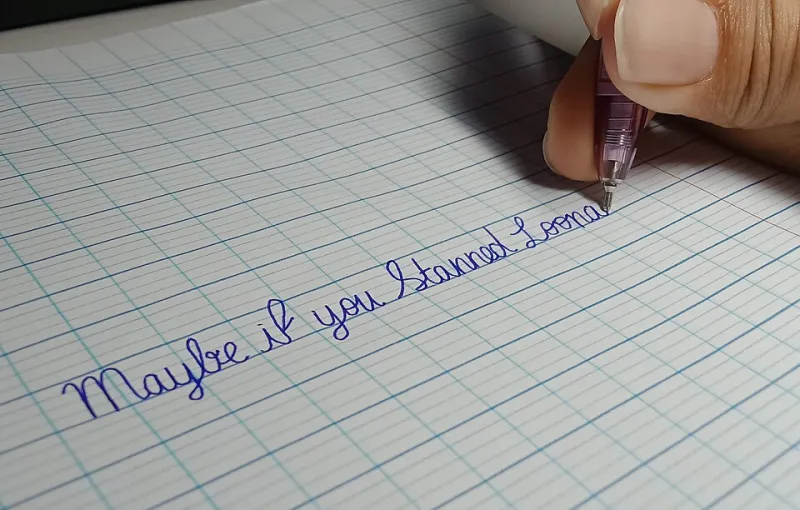
Photo: Jiafei Slay Queen, CC0, via Wikimedia Commons
There is a peculiar phenomenon that many writers — professional and amateur alike — have begun to notice: they can produce thousands of polished words on a screen each day, yet struggle to articulate the same ideas in conversation. The sentences that flow effortlessly through their fingers seem to evaporate somewhere between the keyboard and the mouth. This is not merely anecdotal frustration. A growing body of research in cognitive neuroscience suggests that the medium through which language exits the body shapes, in measurable ways, the language the brain is able to generate in the first place.
The Hand That Wrote the Word Remembered It
For most of recorded human history, writing was a physically demanding, slow, and deliberate act. Forming letters by hand recruits a broad constellation of neural resources — the motor cortex, the cerebellum, areas associated with spatial reasoning, and crucially, regions tied to memory consolidation. Studies conducted by researchers Pam Mueller and Daniel Oppenheimer, widely cited in educational psychology literature, demonstrated that students who took lecture notes by hand retained conceptual information more deeply than those who typed. The reason, the researchers proposed, was that the slower pace of handwriting forced the brain to process and paraphrase rather than transcribe verbatim.
This processing difference is not trivial. When the brain paraphrases — when it must select, compress, and restructure incoming language — it encodes that information at a semantic level, linking new material to existing knowledge networks. Typing, because it permits near-verbatim transcription, can bypass that encoding step entirely. The words pass through the fingers without necessarily passing through the mind in any durable way.
The Keyboard's Shortcut Problem
Modern typing introduces a second layer of cognitive shortcutting that handwriting never could: autocomplete, predictive text, and autocorrect. These features, ubiquitous across smartphones and word processors, intercept the language production process at precisely the moment when the brain would otherwise be forced to retrieve a specific word from its lexical inventory. Retrieval practice — the act of pulling information from memory — is one of the most powerful mechanisms for strengthening neural pathways. When a software algorithm performs that retrieval on the brain's behalf, the pathway goes unexercised.
Over time, this creates what some researchers describe informally as a "lexical dependency" on the interface itself. Users may find that their active vocabulary — the words they can produce spontaneously in speech or unassisted writing — gradually contracts, even as their passive vocabulary, the words they recognize and understand, remains intact or grows. The result is a widening gap between comprehension and production, a divide that linguists have long studied but that digital tools appear to be accelerating.
What Happens to Spontaneous Speech
The implications extend beyond writing. Language production in speech and language production in writing are not wholly separate systems; they share neural infrastructure, particularly in Broca's area and the supplementary motor area, regions involved in planning and sequencing both spoken and written output. When written language production becomes heavily scaffolded by digital tools, there is emerging evidence that spontaneous speech — the kind required in meetings, presentations, or unscripted conversation — can suffer in parallel.
Researchers studying the relationship between writing modality and oral fluency have observed that individuals who compose primarily through typing and voice-to-text technologies sometimes exhibit greater hesitation, increased filler word usage, and reduced syntactic complexity in unscripted speech compared to those who maintain regular handwriting practice. The hypothesis is that handwriting, by demanding a slower, more deliberate engagement with language structure, trains the brain to pre-organize utterances — a skill that transfers to spoken communication in ways that rapid typing does not.
The Medium Shapes the Message — and the Mind
McLuhan's famous dictum that the medium is the message takes on a neurological dimension when applied to writing technology. Different writing tools do not simply change the speed or convenience of composition; they change the cognitive operations the brain performs during composition. Handwriting favors depth of processing. Typing favors speed and volume. Voice-to-text favors immediacy at the expense of revision. Each modality trains different neural circuits, and habitual reliance on any single one leaves others underused.
This does not mean typing is cognitively harmful in any absolute sense. Keyboard fluency enables forms of extended, edited prose that would be exhausting to produce by hand. The concern, rather, is one of balance and awareness. When typing becomes the exclusive mode of language production — when children never learn cursive, when professionals never draft by hand, when composition is always mediated by predictive algorithms — the brain loses practice with the slower, more effortful processes that undergird deep language mastery.
Practical Implications for Learners and Professionals
For language learners, the stakes are particularly high. Research on second-language acquisition consistently shows that writing by hand in the target language strengthens phonological awareness and orthographic memory more effectively than typed practice. The physical act of forming unfamiliar letters and letter combinations appears to anchor sound-symbol relationships in ways that clicking keys does not replicate.
For professionals who depend on verbal communication — lawyers, educators, executives, therapists — the gradual atrophy of unscripted articulateness is a practical liability. Several executive communication coaches in the United States have begun recommending daily longhand journaling not as a nostalgic exercise but as a deliberate cognitive workout, a way of keeping the brain's slower, more generative language circuits engaged.
Educators, meanwhile, face a policy dilemma. Handwriting instruction has been steadily reduced or eliminated across many American school districts in favor of keyboard skills, a shift driven by legitimate concerns about preparing students for a digital workplace. But if the neuroscience of writing modality is taken seriously, the question is not whether to teach typing — it clearly must be taught — but whether eliminating handwriting removes a form of cognitive training that digital tools cannot replicate.
Decoding What We Lose When We Only Type
The ghost in the keyboard is not a supernatural metaphor; it is a cognitive one. What haunts the digital writer is the echo of a more demanding, more integrative form of language production — one that required the whole body to participate in the act of putting thought into words. As researchers continue to map the neural consequences of our shifting writing habits, the picture that emerges is not one of technology making us less intelligent, but of technology quietly redistributing which cognitive capacities get exercised and which quietly atrophy.
For those who wish to remain fluent not just on the screen but in the room — not just in composed prose but in live conversation — the evidence increasingly suggests that the keyboard alone is an insufficient teacher. The brain that writes by hand, at least some of the time, may be the brain that speaks most freely of all.